
Epidural Stem Cell Injections: The Non-Surgical Solution for Degenerative Discs and Sciatica
For working professionals, executives, and active adults, chronic back pain is more than just a physical ailment; it is an invisible disability that derails productivity, drains energy, and drastically diminishes your quality of life. Whether you are sitting through long boardroom meetings or trying to maintain an active weekend lifestyle, the sharp, radiating pain of a damaged spine is impossible to ignore.
If you suffer from Degenerative Disc Disease (DDD), herniated discs, or severe sciatica, traditional medicine usually offers a grim ultimatum: rely on temporary corticosteroid injections and painkillers, or undergo highly invasive spinal fusion surgery.
However, modern regenerative medicine has unlocked a third, vastly superior option. At the Cellular Regeneration Clinic (CRC), we utilize targeted Epidural Stem Cell Injections to repair the spine at a cellular level, offering a non-surgical path to long-term pain relief and structural recovery.
Understanding the Root Cause: Why Your Back Hurts
To understand why epidural stem cell therapy is so effective, we must first look at the mechanical failure happening inside your spine.
The human spine is cushioned by intervertebral discs—rubbery, shock-absorbing pads located between each vertebra. These discs consist of a tough outer layer (the annulus fibrosus) and a soft, jelly-like core (the nucleus pulposus). Over time, due to age, repetitive stress, or acute injury, these discs begin to fail.
- Degenerative Disc Disease (DDD): As we age, the discs lose hydration and elasticity. They flatten out, reducing the space between vertebrae and causing bone-on-bone friction and severe inflammation.
- Bulging and Herniated Discs: When the tough outer layer of the disc cracks or tears, the inner jelly bulges out. This bulging material physically presses against the highly sensitive spinal nerves.
- Sciatica: When a herniated disc or inflamed tissue impinges on the sciatic nerve (the large nerve running down the lower back and legs), it causes excruciating, radiating pain, numbness, and tingling known as sciatica.
Because the spinal discs have notoriously poor blood supply, they possess almost zero natural ability to heal themselves once damaged. This is why traditional treatments fail to provide lasting relief.
Why Traditional Treatments Fall Short
Standard pain management focuses entirely on symptom suppression rather than structural repair.
Epidural corticosteroid injections are commonly prescribed to reduce nerve inflammation. While they may provide temporary pain relief (often lasting just a few weeks or months), steroids are highly catabolic. Multiple studies have shown that repeated cortisone injections actually degrade cartilage and weaken spinal ligaments over time, ultimately accelerating the degeneration of your spine.
Conversely, surgical interventions like spinal fusions permanently alter the biomechanics of your back. By fusing two vertebrae together, the surgery forces the adjacent, healthy discs to bear extra mechanical stress, frequently leading to “adjacent segment disease” and the need for further surgeries down the line.
The Regenerative Solution: Epidural Stem Cell Injections
Stem cell therapy fundamentally changes the paradigm of spinal care. Instead of masking the pain or permanently fusing bones, we introduce powerful biological healing agents directly into the site of the damage to repair the tissue.
While standard stem cell back treatments are often injected “paraspinally” (into the muscles and ligaments surrounding the spine), severe cases of herniation and sciatica require a much more precise approach: The Epidural Injection.
What is the Epidural Space?
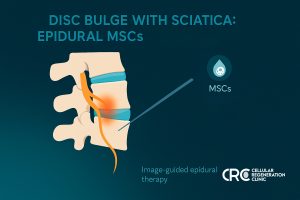
The epidural space is the protective area located inside the spinal canal, sitting just outside the *dura mater* (the membrane that encases the spinal cord and nerve roots). By injecting stem cells directly into this highly specific anatomical space, the regenerative cells are physically trapped exactly where the bulging disc and the inflamed nerve roots are located.
The Clinical Advantage of an Anesthesiologist
Administering biologics into the epidural space requires extreme precision. It cannot be performed by a standard general practitioner in a typical office setting.
At Cellular Regeneration Clinic, our epidural stem cell protocols are administered exclusively by a Board-Certified Anesthesiologist in a clinical operating room setting. Utilizing advanced imaging guidance, our anesthesiologist ensures that the needle safely bypasses surrounding tissues and deposits the highly concentrated dose of 25-50 Million Mesenchymal Stem Cells (MSCs) and 3 Billion Exosomes directly into the epidural space.
The clinical advantage of this route is profound: Retention. Because the cells are locked into the epidural space, they do not wash away into the bloodstream. They remain heavily concentrated around the damaged disc, allowing them to continuously receive the chemical “SOS” signals emitted by the inflamed tissues.
The Biological Healing Process: How MSCs Repair Your Back
Once the Mesenchymal Stem Cells and Exosomes are safely deposited into the epidural space, they initiate a highly complex, two-phase healing cascade that takes place over the course of 2 to 4 months.
Phase 1: Massive Inflammation Reduction (Pain Relief)
The immediate goal of the stem cells is to alter the toxic environment surrounding the spinal nerves. A herniated disc leaks highly acidic, inflammatory proteins that burn the sciatic nerve. MSCs are the most potent anti-inflammatory agents in human biology. They secrete powerful cytokines that neutralize these inflammatory proteins, turning off the “fire” around the nerve roots. This process alone dramatically reduces the physical swelling and relieves the excruciating pain of sciatica.
Phase 2: Tissue Regeneration and Structural Repair
Once the inflammation is cleared, the true regenerative work begins. MSCs possess the unique ability to differentiate (transform) into specific cell types, including chondrocytes (cartilage cells) and tenocytes (tendon and ligament cells).
Working in tandem with the 3 Billion Exosomes (which act as chemical messengers commanding your older cells to work harder), the stem cells stimulate the production of a new collagen matrix. This helps to rehydrate the degenerated disc, repair the microscopic tears in the outer annulus, and stabilize the spinal segment.
According to extensive clinical data published on PubMed, MSCs can significantly improve disc height, increase hydration within the nucleus pulposus, and reverse the progression of degenerative disc disease.
What to Expect: The Procedure and Recovery
Many patients assume that spinal stem cell therapy is a highly invasive process. In reality, it is a fast, outpatient procedure.
The epidural administration is performed under a local anesthetic and is generally painless—comparable to receiving a standard epidural corticosteroid injection. The actual administration of the cells takes only a few minutes. Following a brief observation period to ensure you are stable to walk, you are free to leave the clinic the exact same day.
Critical Pre- and Post-Treatment Guidelines
Because stem cells rely on inflammatory signals to find the exact location of the damage, patient compliance regarding medication is crucial:
- Avoid NSAIDs: You must strictly avoid non-steroidal anti-inflammatory drugs (like Ibuprofen, Advil, or topical Voltaren) for 1 week prior to the procedure and 10 to 14 days after. Artificially reducing inflammation with pills “blinds” the stem cells.
- Avoid Steroids: Localized steroid injections must be avoided for 2 weeks prior to treatment.
- Activity Levels: While you can walk the same day, you must avoid heavy lifting or intense exercise for the first few weeks to allow the cells to anchor and begin the healing process.
Why the Best Spinal Treatments Require “Day 0” Cells
If you have consulted with stem cell clinics in the United States, you have likely been offered treatments using your own bone marrow or fat cells. Due to strict FDA regulations, US clinics are legally prohibited from expanding (multiplying) stem cells in a laboratory.
This presents a massive biological flaw: Your stem cells age exactly as you do. If you are 55 years old with degenerative discs, extracting your own 55-year-old, exhausted stem cells and injecting them into your spine will yield poor results.
At CRC, we operate under explicit federal licensing from the Mexican Health Authority (COFEPRIS). This allows our in-house laboratory (ITC) to legally cultivate ethically sourced, “Day 0” Umbilical Cord Stem Cells. These cells are biologically young, incredibly potent, and possess maximum regenerative capacity.
Furthermore, because we own the laboratory, we guarantee our cell quality. Every patient receives a 5-page Certificate of Authenticity proving an exact cell count, absolute purity, and a viability rate of 99.99%. You will never receive a “blind injection” at CRC.
Conclusion: Reclaim Your Spine and Your Career
You do not have to accept chronic back pain as a permanent fixture of your life, nor do you have to subject your body to the permanent alterations of spinal fusion surgery.
By utilizing an Epidural Stem Cell Injection, administered by a highly skilled Anesthesiologist, you can safely deliver millions of potent regenerative cells directly to the source of your pain. Heal your degenerated discs, quiet your inflamed sciatic nerves, and return to your career and active lifestyle with a structurally sound spine.
*Disclaimer: Outcomes will vary between individuals. No claims are being made with regenerative therapies. More than one round of treatment may be required. The FDA considers stem cell therapy experimental. Please consult with our medical team to see if you are a candidate.
