
Slowing Progressive Neurodegenerative Diseases: The Role of Intrathecal Stem Cells
Receiving a diagnosis for a progressive neurodegenerative condition is a deeply challenging experience. Conditions like Parkinson’s Disease and Multiple Sclerosis (MS) steadily attack the central nervous system over time This progressive damage often leads to severe cognitive and physical impairments .
Traditional medicine typically focuses on managing symptoms as they arise. However, patients and their families are often desperate for scientifically backed ways to slow the actual deterioration of the brain and spine .
At the Cellular Regeneration Clinic (CRC), we offer a proactive approach . Our advanced regenerative therapies have been shown to help repair neural tissue and significantly reduce neuroinflammation . To achieve these results, we must overcome the body’s most complex defense mechanism.
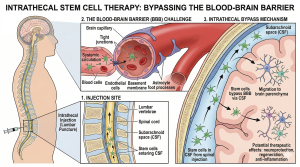
The Challenge of the Blood-Brain Barrier
The human brain is an incredibly delicate organ. Therefore, the body relies on a strict security system known as the Blood-Brain Barrier (BBB) .
The BBB acts as a microscopic filter. It effectively separates your circulating blood from the brain tissue . This barrier is excellent at keeping dangerous toxins and infections out of your central nervous system .
Unfortunately, the BBB also creates a massive hurdle for modern medical treatments. When you receive a standard intravenous (IV) drip, the medication enters your bloodstream . Because stem cells are relatively large biological molecules, the BBB blocks almost all of them from entering the brain.
If you rely only on an IV drip, your brain will not receive a sufficient dose of healing cells. To achieve true neural regeneration, we must bypass your bloodstream entirely .
The Medical Necessity of Intrathecal Administration
To successfully bypass the Blood-Brain Barrier, our medical experts utilize a highly precise delivery method known as Intrathecal Administration .
Instead of injecting cells into a vein, we place them directly into your spinal canal . This specialized area contains cerebrospinal fluid. This fluid constantly circulates around your spinal cord and directly bathes your brain.
By placing the stem cells directly into this fluid, we provide them with a clear and open pathway. The fluid effortlessly carries the regenerative cells straight to the damaged neuronal tissue inside your brain.
The Role of the Anesthesiologist
Accessing the intrathecal space requires absolute clinical precision. A standard general practitioner cannot perform this procedure safely. At CRC, our Board-Certified Anesthesiologist performs this administration . We conduct the procedure in a sterile, clinical operating room .
Using specialized techniques, the Anesthesiologist safely introduces the cells via a lumbar puncture . The procedure is fast, and we use a local anesthetic to minimize discomfort . Many patients experience a smooth process and recover on the exact same day .
How Stem Cells Support the Brain and Spine
Progressive conditions like MS and Parkinson’s cannot be permanently cured However, stem cell therapy has been shown to partially improve symptoms and slow down future deterioration . The healing process happens through several biological pathways.
First, the stem cells target chronic neuroinflammation. Following a disease flare-up, the brain often becomes highly inflamed. Stem cells act as powerful anti-inflammatory agents . They can help reduce physical pressure within the brain and prepare the damaged areas for repair .
Next, the cells promote active neural regeneration. Mesenchymal Stem Cells possess the unique ability to differentiate into neural cells [14]. Furthermore, they have been shown to help repair the myelin sheath . This protective nerve coating makes up a large portion of the brain and is severely damaged by conditions like Multiple Sclerosis .
Finally, the stem cells can replicate themselves inside the spinal fluid. This replication creates more exosomes over time . Consequently, this sets off a longer-term healing cascade that can help protect the brain for months after the procedure.

The Importance of Systemic IV Therapy
While the spinal injection specifically targets the brain, progressive diseases also affect your entire body . For this reason, we strongly recommend combining the intrathecal procedure with a systemic IV infusion .
The IV therapy delivers a large dose of cells directly into your bloodstream . The blood carries these cells to your peripheral nervous system [15]. This approach can help repair nerve damage in your arms, legs, and gut.
Additionally, chronic illnesses force your internal organs to work much harder to compensate . Long-term medication use also heavily strains your liver and kidneys . The IV stem cells can help regenerate these overworked secondary organs and prevent future systemic damage .
Moving Forward with Confidence
We understand that living with a progressive neurodegenerative condition is incredibly difficult. While results will vary and multiple treatments are often required, regenerative medicine offers a proactive and scientifically backed option.
By utilizing intrathecal administration to bypass the Blood-Brain Barrier, we deliver nature’s best healing mechanism right to the source of the injury . This comprehensive approach aims to preserve your independence, slow disease progression, and improve your overall quality of life .
Take the next step in your health journey. Schedule a Free Consultation with our Specialists today.
*Disclaimer: No positive outcome of any medical treatment is promised or implied. More than one round of treatment may be required. All sales are final with no refunds regardless of patient outcome. Results may vary between patients, as with all medical treatments there is no guarantee of any particular outcome. Please consult with our medical team to see if you are a candidate.
